

The "trouble" of stainless steel - corrosion problem
In the grand map of modern industry and daily life, stainless steel is undoubtedly a "versatile", widely used in many fields such as construction, chemical industry, food processing, medical equipment, etc. due to its excellent strength, corrosion resistance, and aesthetics. From towering skyscrapers to the tableware we use in our daily lives, stainless steel is ubiquitous.
However, even such a highly favored material faces a stubborn 'enemy' - corrosion. Corrosion is like a hidden 'killer' in the dark, silently eroding the performance and lifespan of stainless steel, causing serious harm and huge losses to various industries. In the chemical industry, stainless steel equipment is exposed to various corrosive media such as strong acids and alkalis for a long time. Once corrosion occurs, it may not only lead to equipment leakage, environmental pollution and safety accidents, but also cause production interruption and huge economic losses. According to relevant data statistics, the economic losses caused by metal corrosion worldwide reach hundreds of billions of dollars annually, with stainless steel corrosion accounting for a significant proportion. In the field of construction, corrosion of stainless steel structural components can reduce the structural stability of buildings, shorten their service life, and the cost of repairing and replacing these components should not be underestimated. In daily life, corrosion of stainless steel products not only affects their aesthetics, but may also affect their functionality. For example, stainless steel sinks in the kitchen are prone to bacterial growth after corrosion, posing a threat to family health.
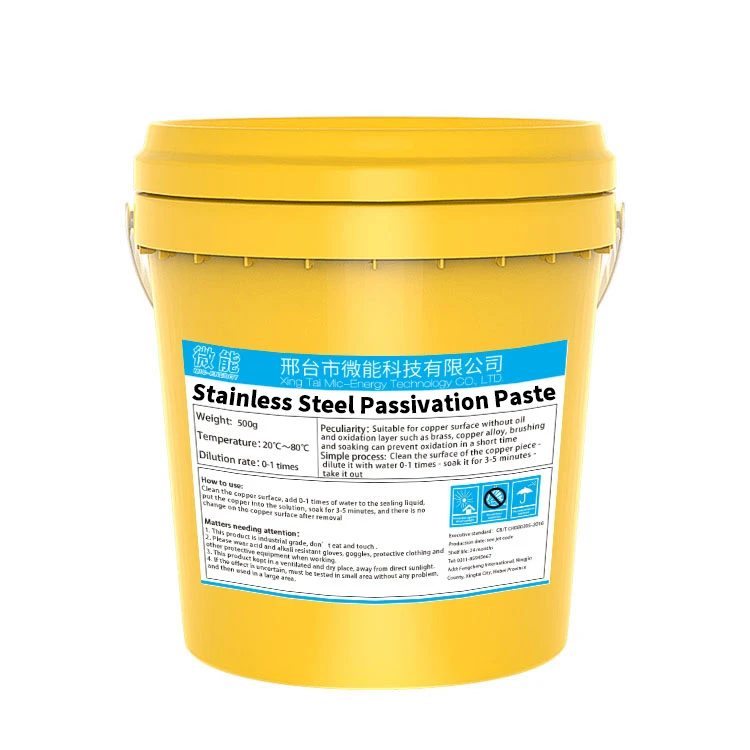
Stainless steel passivation paste
(1) Definition and Essence
Stainless steel passivation paste is essentially a chemical agent specifically used for surface treatment of stainless steel. It is like a magical "beautician" who can perform acid pickling and passivation treatment on the surface of stainless steel, effectively removing various defects that occur during the processing of stainless steel, such as yellow, blue, and black welding spots after welding, oxide scales left by high-temperature processing, rust spots, black spots, etc., making the surface of stainless steel look brand new.
(2) Development History
The development process of stainless steel passivation paste is a technological history of continuous innovation and progress. In the early days, in order to solve the corrosion problem of stainless steel, people began to explore various surface treatment methods, and stainless steel passivation paste emerged. At first, its formula and performance were relatively simple, and its processing effect was limited. With the continuous advancement of technology and the increasing demand of industry, researchers have invested a lot of energy in in-depth research and improvement of stainless steel passivation paste.
In terms of formula optimization, through continuous experimentation and screening of various chemicals, more efficient and environmentally friendly formulas have been developed. The new formula not only thoroughly removes impurities from the surface of stainless steel, but also forms a denser and more stable passivation film on the surface, greatly improving the corrosion resistance of stainless steel. In terms of manufacturing process, it has gradually developed from traditional simple mixing process to the use of advanced synthesis technology and precision production equipment, ensuring the stability and consistency of passivation paste quality. For example, some advanced production processes can precisely control the proportion of each component and reaction conditions, thereby producing high-performance stainless steel passivation paste.
Nowadays, there are various types and specifications of stainless steel passivation paste on the market, which can meet the needs of different industries and application scenarios. From high-capacity passivation paste suitable for large industrial equipment to high-performance passivation paste specifically for precision components, its application range continues to expand, providing strong support for the wide application of stainless steel in various fields.
Performance feature display
(1) Efficient cleaning capability
The cleaning ability of stainless steel passivation paste is excellent, demonstrating strong "cleaning power" in many practical application scenarios. Taking a large food processing plant as an example, after long-term use, the stainless steel equipment on its production line accumulates a large amount of stubborn stains and oxide layers caused by food residues, oils, and high-temperature processing on its surface. These stains not only affect the appearance of the equipment, but may also pose a potential threat to food safety. When using stainless steel passivation paste for treatment, simply apply the passivation paste evenly on the surface of the equipment, pause for a moment, and you can easily see the paste reacting quickly with the stain. The stains that originally adhered to the stainless steel surface seemed to be pulled down by an invisible force. With subsequent rinsing with clean water, the equipment surface was refreshed and restored to its original brightness and cleanliness. According to feedback from operators, compared to ordinary cleaning agents used in the past, the cleaning efficiency of stainless steel passivation paste has been improved several times. It not only greatly saves cleaning time and labor costs, but also has a more thorough cleaning effect, effectively ensuring the hygiene and safety of the food processing environment.
In the field of architectural decoration, stainless steel passivation paste also performs well. Some outdoor stainless steel building decorative components have been exposed to the air for a long time, and have been affected by wind, sun, rain erosion, and pollutants in the air, resulting in rust spots, dirt, etc. on the surface. After treatment with stainless steel passivation paste, these rust spots and dirt were quickly removed, and the stainless steel surface regained its bright luster, giving the building a completely new appearance. For example, the stainless steel facade of a landmark building in a certain city has become dull after years of use. After partial treatment with stainless steel passivation paste, the treated area forms a sharp contrast with the untreated area, and the treated part is as bright as new, fully demonstrating the powerful cleaning ability of stainless steel passivation paste.
(2) Excellent passivation effect
One of the core values of stainless steel passivation paste is its ability to significantly enhance the corrosion resistance of stainless steel, which has been fully validated through a series of data and practical cases. Comparative testing was conducted on stainless steel samples treated with stainless steel passivation paste and untreated samples in a laboratory environment. Two sets of samples were placed in a corrosive solution environment at the same time. After a period of observation, it was found that the untreated stainless steel samples had obvious corrosion marks on the surface, such as rust spots, pits, etc; The sample treated with stainless steel passivation paste still maintains a relatively intact surface with only slight signs of corrosion. The corrosion rate of the sample was measured using professional testing equipment, and the results showed that the stainless steel sample treated with stainless steel passivation paste had a corrosion rate several times lower than the untreated sample. This intuitively indicates that the stainless steel passivation paste significantly improves the corrosion resistance of stainless steel.
In practical applications, there are also numerous cases that have demonstrated the excellent passivation effect of stainless steel passivation paste. The stainless steel reaction kettle of a certain chemical enterprise is used for long-term storage and reaction of highly corrosive chemicals. After regular treatment of the reaction vessel with stainless steel passivation paste, its service life was significantly extended. In the past, when passivation paste was not used for treatment, the reaction kettle needed to be repaired and some components replaced every once in a while. However, after using passivation paste for treatment, the maintenance cycle was significantly extended, which not only reduced equipment maintenance costs but also improved production continuity and stability. For example, a stainless steel bridge in a coastal area has a high risk of corrosion due to long-term exposure to sea winds and seawater erosion. After using stainless steel passivation paste for protective treatment, the corrosion resistance of the bridge has been greatly improved. After years of use, it still maintains good structural performance, providing reliable guarantee for traffic safety.
(3) Good applicability
Stainless steel passivation paste has a wide range of applicability and can meet the needs of different types of stainless steel and various complex scenarios. From common austenitic stainless steels such as 304, 316, 316L, to martensitic and ferritic stainless steels such as 410, 430, stainless steel passivation paste can exhibit its excellent properties. In industrial production, whether it is large stainless steel storage tanks, pipelines, or precision stainless steel components, stainless steel passivation paste can be used for surface treatment. For example, in the petrochemical industry, large stainless steel storage tanks need to have good corrosion resistance to store various flammable and explosive chemical raw materials. Stainless steel passivation paste can be evenly applied to the surface of the storage tank to form an effective passivation film, ensuring that the tank will not experience safety accidents such as leakage due to corrosion during long-term use.
In daily life scenarios, stainless steel passivation paste also has great potential. For stainless steel tableware, kitchenware, bathroom facilities, etc. in the home, when there are stains and rust spots on their surfaces, using stainless steel passivation paste for simple treatment can restore their brightness and extend their service life. Moreover, the use of stainless steel passivation paste is relatively simple, and even ordinary consumers can easily operate it. In addition, in some special scenarios, such as stainless steel equipment in high-temperature environments, stainless steel structures in humid environments, etc., stainless steel passivation paste can also adapt and play a good role. In high-temperature environments, its composition can remain stable, effectively preventing the performance degradation of stainless steel caused by high-temperature oxidation; In humid environments, the formed passivation film can effectively block the erosion of moisture and oxygen, ensuring that the corrosion resistance of stainless steel is not affected.