

Aluminum alloy, as a high-performance metal material, is widely favored in modern industry. However, its bright surface may become a quality or aesthetic hazard in certain specific situations. In order to improve this problem, the blackening treatment process for aluminum alloys has emerged. This process forms a black oxide layer on the surface of aluminum alloy, which not only changes its appearance, but also significantly improves its corrosion resistance and wear resistance. Next, we will delve into the principles, detailed steps, and advantages and disadvantages of the blackening process for aluminum alloys in practical applications.
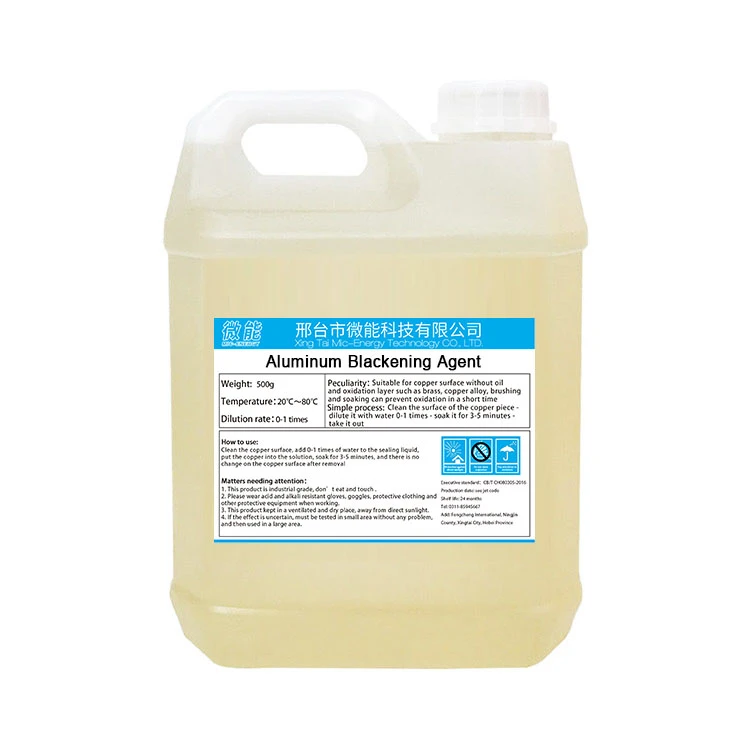
Aluminum alloy blackening agent is a blackening agent specifically designed for aluminum and aluminum alloys, usually a colorless and transparent alkaline solution. This blackening agent is mainly used for various aluminum alloy ingredients such as aluminum extruded parts, stamped parts, and die cast aluminum. During use, it is necessary to strictly control the temperature of the working fluid below 35 ℃ to avoid excessive corrosion of the aluminum parts and the loosening and peeling of the black film.
The components of aluminum alloy blackening agent may include copper sulfate, sodium selenite, zinc dihydrogen phosphate, citric acid, etc. Its pH value is about 3, and the blackening treatment time is 5-7 minutes. It can be used at room temperature. However, the effect of blackening treatment is influenced by various factors, such as the surface state of the material, the parameters of the treatment process (such as temperature, time), and the concentration of black liquor.
In practical applications, it is necessary to adjust and optimize the processing technology according to specific situations to achieve the desired blackening effect. In addition, protective tools should be worn during operation to prevent alkaline solutions from corroding the body's skin.
The principle of blackening process for aluminum alloy
The blackening treatment of aluminum alloy is essentially the formation of a black aluminum oxide film on its surface. This process involves a chemical reaction between aluminum and oxygen to produce a dense layer of aluminum oxide. By carefully controlling processing conditions such as temperature and time, precise control of the thickness and structure of the oxide layer can be achieved, giving aluminum alloys a black appearance.
The steps of blackening process for aluminum alloy
The blackening process of aluminum alloy involves multiple key steps. Firstly, surface preparation includes cleaning to remove grease and oxides, ensuring a clean and flawless surface. Next is oxidation treatment, which places the aluminum alloy under specific atmosphere and temperature conditions to promote oxidation reactions on its surface. Afterwards, cooling and cleaning steps are required to stabilize the oxide layer and further purify the surface. Finally, in order to enhance the protective performance of the oxide layer, sealing treatment may also be necessary.
Through this series of meticulous processes, the blackening treatment of aluminum alloy not only endows the material with new appearance characteristics, but also achieves significant improvements in corrosion resistance and wear resistance.
After oxidation treatment, the aluminum alloy sample needs to be taken out of the oxidation tank, cooled, and then cleaned. This step aims to remove residues from the oxidation tank and ensure the cleanliness of the product surface. During the cleaning process, water or solution can be used for thorough cleaning to remove attachments and impurities.
Next, the cleaned aluminum alloy samples need to be sealed to enhance the corrosion resistance and wear resistance of the oxide layer. Sealing treatment is carried out by hot water, steam or chemical solution, and the sample is placed in a sealed groove for processing. This step helps to seal the pores of the oxide layer, thereby further enhancing the corrosion resistance of the product.
The blackening process of aluminum alloy is widely used in multiple fields. In the field of decoration, its unique black appearance and texture can significantly enhance the overall quality of the product. In the field of home furnishings, blackened aluminum alloy products not only look beautiful, but also have excellent corrosion resistance and wear resistance, suitable for various complex usage environments. In addition, in the field of electronic products, this process can also provide excellent electromagnetic shielding and heat dissipation performance, enhancing the reliability and stability of the product.
However, there are also some challenges in the blackening process of aluminum alloys. Due to the relatively low surface hardness of aluminum alloy after blackening treatment, it is prone to scratches and wear, so careful use and maintenance are required. At the same time, the surface of the product is prone to absorbing dust and dirt, requiring regular cleaning to maintain its appearance. However, these shortcomings have not concealed the significant advantages of aluminum alloy blackening treatment process in improving product appearance and performance.
The color stability of the aluminum alloy surface after blackening treatment does have certain limitations. Due to the influence of ultraviolet radiation and chemical substances, the surface of the product may gradually change color, which to some extent affects its aesthetics. Nevertheless, the blackening process of aluminum alloys still plays an important role in multiple fields, significantly improving their corrosion resistance and wear resistance by altering their appearance.